UNDERGRADS 2026

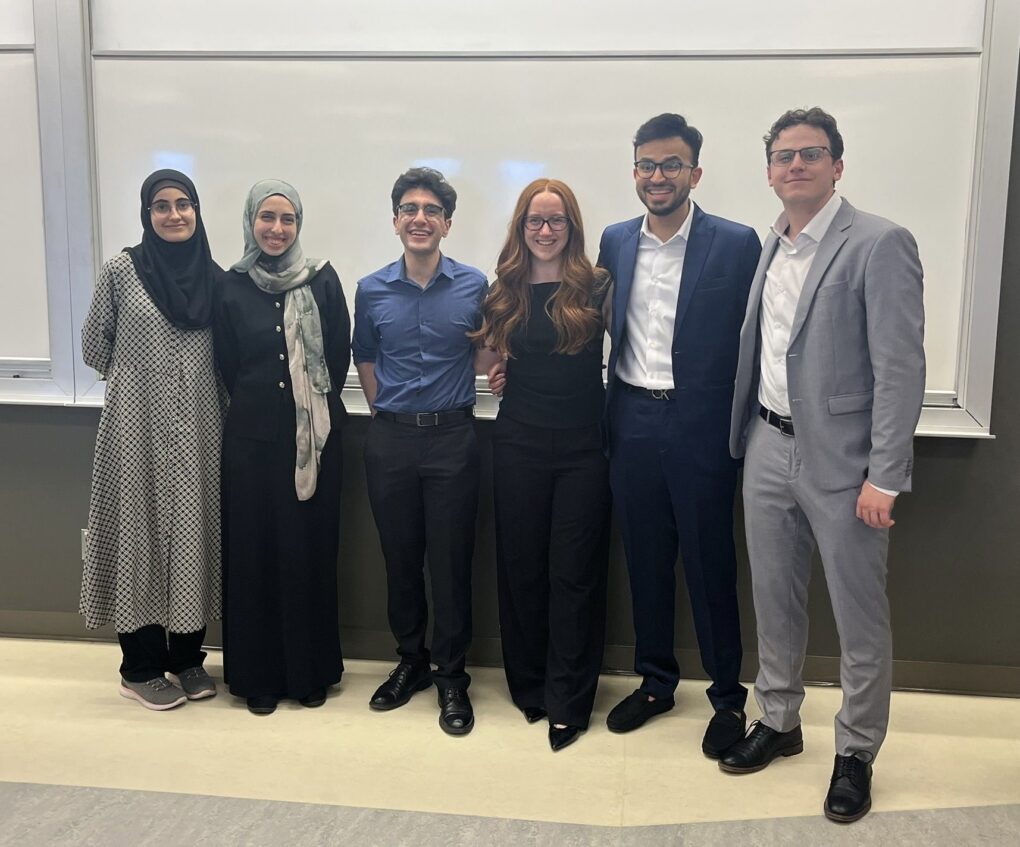
Sara Al-Noor, Tasneem Labak, Adam Bakos, Kaitlin Ferraro, Tejas Patel, Noah Cleary
Tasneem Labak
Glioblastoma (GBM) is the most common and lethal primary malignant brain cancer. Despite standard treatments, the average life expectancy is only about 15 months, and majority of patients experience recurrence of this aggressive cancer within a couple years of their initial diagnosis. A major obstacle that prevents successful treatment of GBM is the presence of glioma stem cells (GSCs), a small group of tumour cells that can evade standard of care treatment and regrow the tumour. This challenge is aggravated by components of the tumour microenvironment, including endothelial cells (ECs), that may enhance the maintenance of GSCs through the secretion of critical factors and direct cell-cell contact interactions. The complexity of this interaction is further heightened by the presence of notable GSC cell-surface markers, CD44 and CD133, which can be present alone or in combination as different subpopulations of GSCs. These GSC subpopulations can potentially interact with ECs in different ways to promote GBM aggressiveness. My research focuses on exploring this intricate interaction using patient-derived GSCs, graciously provided by Windsor Regional Hospital and Henry Ford Hospital, along with endothelial cells in in vitro experiments. We also utilize an in vivo fluorescent zebrafish model that allows us to study the interaction between the vasculature and patient-derived GSC subpopulations.
 
My journey in Porter Lab has been one of the most transformative and rewarding experiences of my undergraduate career. During my first year in lab, I built a foundational understanding of cancer cell biology and was exposed to its applications through shadowing upper-year researchers and participating in the Peer Mentoring Network. Over the years, I developed key skills in lab technique, critical thinking, and collaboration, which proved instrumental when I was given the privilege of having my own research project. From my very first moment in lab, I have been supported by a team of talented researchers that have fostered my personal growth and deepened my appreciation for the intricacies of cancer research. I am extremely grateful for the precious mentorship, support, and opportunities that Dr. Porter, Dr. Lubanska, and the entire Porter Lab team have provided me. This journey has inspired me to continue contributing to scientific discovery and the broader fight against cancer!
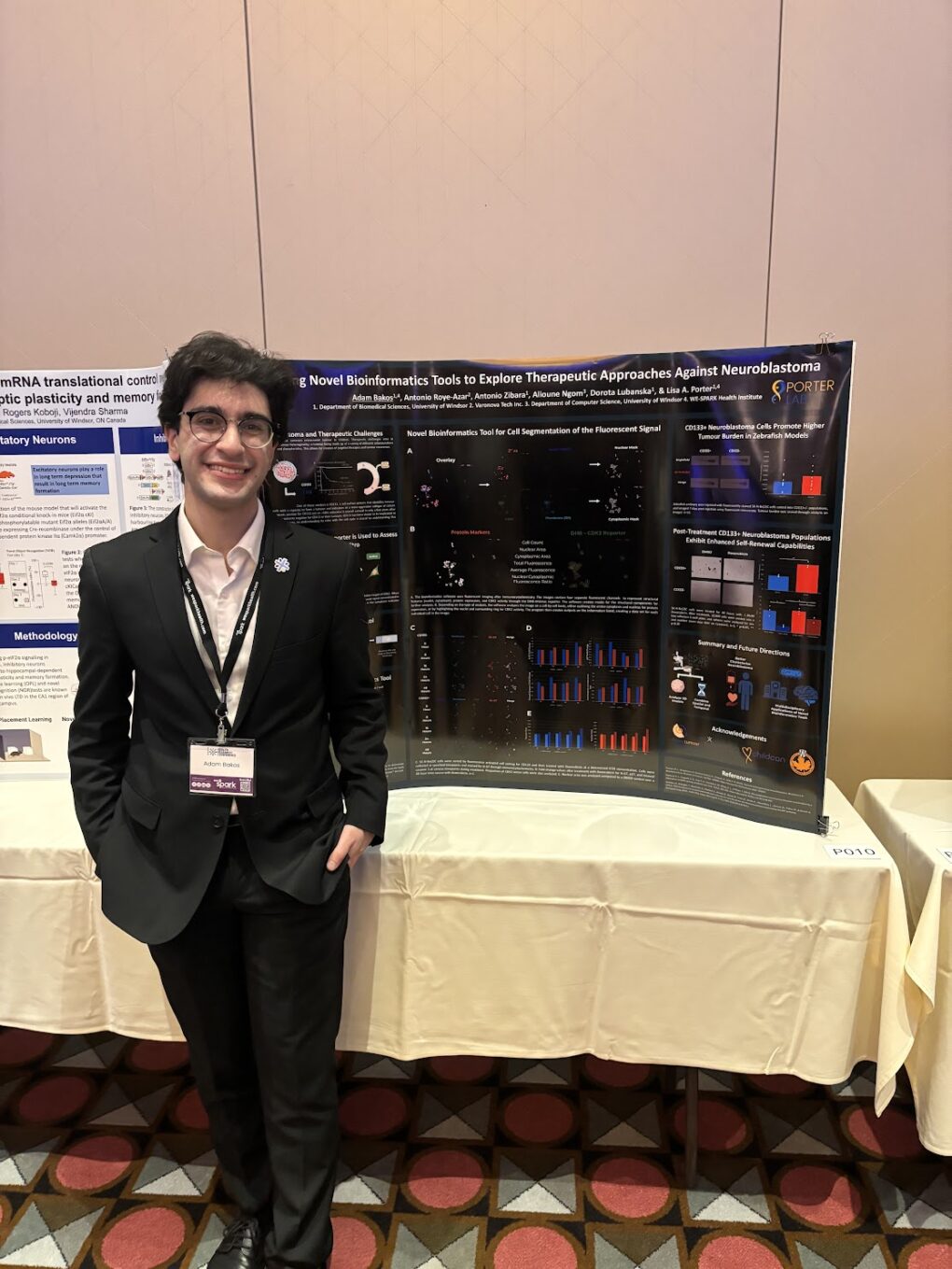
My project studies neuroblastoma, a cancer arising from the nervous system, and the most common extracranial tumour in children. A challenge when treating high-risk neuroblastoma is “intra-tumoral heterogeneity”, or the idea that one tumour can be comprised of sub-populations of different cell types, each with unique characteristics and markers. This nature of neuroblastoma makes targeted therapies somewhat ineffective, and thus, my project looks towards an efficient and effective way to analyze protein activity within a neuroblastoma model on a cell-by-cell basis. Through a collaboration with the Department of Computer Science, I have optimized and utilized a high-throughput bioinformatics tool called “ICCell” to help us determine abundance, localization, and activity of various proteins using fluorescent microscopy. This tool not only helps advance knowledge on neuroblastoma, revealing potential targets for treatment, but can be applied across multiple disciplines in biomedical sciences or various general science research fields.
 
My time in the Porter Lab over the past three years has been nothing short of highly motivating and rewarding. I have grown close to so many mentors and friends throughout this journey, all of which have shaped who I am as both a researcher and a person. Further, the opportunities I have had to expand my research, namely through the Brain Tumour Foundation of Canada Summer Studentship, have not only helped advance my knowledge, but more importantly, connected me with a community of individuals who share the same passion for this field of healthcare. I am beyond grateful for all the guidance I’ve received from Dr. Porter, Dr. Lubanska, and the entire Porter Lab team; this experience has solidified my passion and interest for pursuing a future career to help advance cancer research.
Adam Bakos
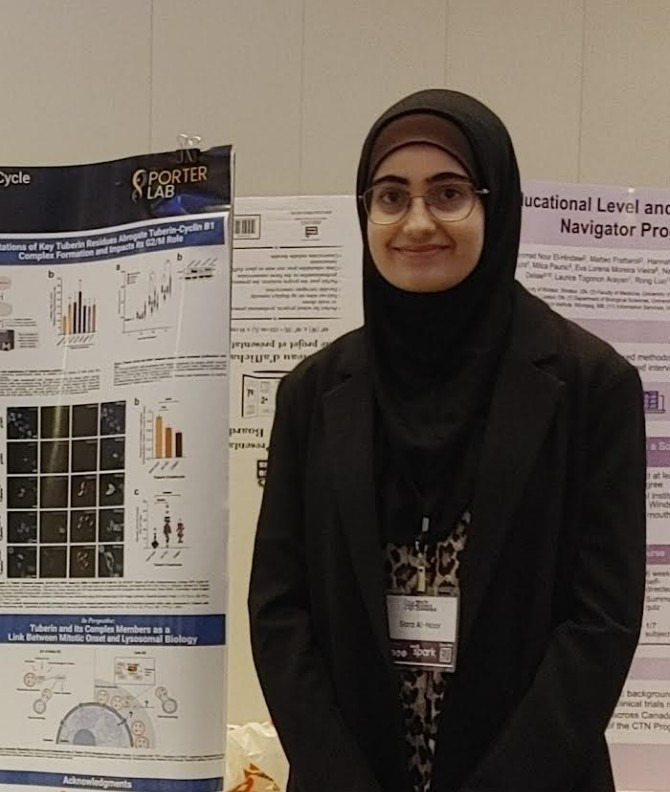
Sara Al-Noor

Tuberous Sclerosis Complex (TSC) is a rare genetic disorder caused by mutations in the TSC1 and TSC2 genes, which encode the proteins Hamartin and Tuberin. Together, these proteins regulate cell growth, nutrient-responsive signaling, and tumor suppression. As a result, TSC is associated with abnormal cell division and tumour formation in multiple organs, including the brain, kidneys, lungs, and skin. Our lab studies Tuberin and its role in cell cycle regulation, where it binds cyclin B1 and delays mitotic onset, allowing cells more time to grow and prepare for division. Previous BioID proximity-labeling studies performed in our lab identified LAMTOR1, a lysosomal scaffold protein involved in nutrient sensing, as the only protein to co-enrich with Tuberin, Hamartin, and CDK1 under stringent criteria. My project investigates the relationship between Tuberin and LAMTOR1 through localization and interaction studies to better understand whether these proteins may contribute to a mechanism linking nutrient sensing with cell cycle regulation.

My journey in Porter Lab has been one of the most rewarding experiences of my undergraduate career, and I have grown tremendously both scientifically and personally since joining the lab. Through the Peer Mentor Network, I had the opportunity to learn about the research projects of thesis students while I was still a pre-project student, which further strengthened my interest in research and allowed me to learn from students I looked up to as role models. I also had the opportunity to shadow students in the lab, develop new technical and critical thinking skills, and gradually grow more confident in my own abilities as a researcher. Over the past year, I have been able to present my research and further develop my communication and problem-solving skills while gaining a much deeper appreciation for the complexity of scientific discovery. I am extremely grateful for the mentorship and support I have received from Dr. Porter, Dr. Fidalgo Da Silva, and the entire Porter Lab team, whose guidance and encouragement have made my undergraduate research experience incredibly meaningful. The experiences and skills I have gained in Porter Lab will continue to support me throughout my future in science and research.

Facebook
X
LinkedIn
Reddit
WhatsApp
Email
Print

Leave a Comment

Your email address will not be published. Required fields are marked *

Interested in joining Porter Lab?

Positions available

Research Assistant position

No position is available at the moment.

Graduate students

For interested graduate students please visit the University of Windsor Department of Biology for admission requirements (http://www1.uwindsor.ca/biology/graduate-program) and contact Dr Bre-Anne Fifield (fifield@uwindsor.ca) to express your interest in joining the lab.

Volunteers

For volunteers please contact Dr Dorota Lubanska (lubanskd@uwindsor.ca) and indicate the year you are in and the type of experience you are interested in.  Note that interviews only happen once a year in the Spring.

Interested in joining wcrg?